Saturday, June 16, 2012

Umbilicals...something to think about and it aint good.

Photo courtey of http://colinhaley.blogspot.com/


Like may of us I suspect, I have thought that factory umbilical attachments were best done in a steel or aluminum "loop" that could be directly clipped with your umbilical biner of choice. Having climbed a bunch on Cobras, the newest Fusions, new Ergos and Nomics (old and new) and the original Quark I am rethinking that idea.


photo courtesy of http://colinhaley.blogspot.com/


I really rely on my umbilicals. As much as they are a moving belay for me I also have come to rely on them to retain my tools while climbing leashless. On the occasions I do climb without umbilicals I am very careful to watch where my tools are all the time and that they are securely placed. And I don't worry about my partners kicking or bumping them off the climb. May be I should be more concernedall the time..


I've notice that those that don't choose to use umbilicals aren't always very careful on where they leave their own tools. To the point of a couple of winters ago wepicked up several sets of tools left behind simply because the climbers who owned the tool forgot them at a rap station or even just left them on the ground at the base of a climb. (hard to blame that on umbilicals I guess :) Or just as bad, set them somewhere they could easily be knocked off (by the owner,their partner or rock and ice fall) at a belay station.


But the issue that just became readily apparent to me is clipping carabiners to a metal umbilical attachment points has a huge disadvantage. That is, the wire gate biners tripping themselves open and dropping the tools in use. You can't just ignore where the tool is and what is happening when it is a metal to metal contact between umbilical and tool. None of the carabiner based umbilicals have any advantage here..."no matter how strong the the binergate is" as one manufacturer's rep told me.


Rope tie on points won't solve the entire issue. But they will help make the umbilical biners less likely to pop off the tool. Tonight, as good as the BD tool design work is, I added perlon loops to both my Fusions and Cobras all the while negating the full strength metal attachment pointson both tools. The reason?I'd rather have a less than full strength umbilical attachment point than loosea tool because the umbilical biner ever so easily snapped off the tool by accident.


photo courtesy of http://www.alpineexposures.com/pages/chamonix-conditions


Pays to always think and rethink your own systems.

Friday, June 15, 2012

Regaining ground in the park, the NPS makes its move

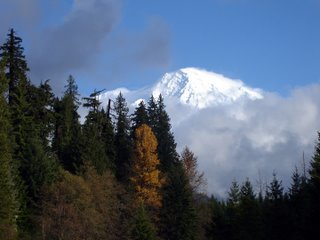
The skies parted for a while today and the mountain finally revealed itself. Plastered ice and snow coated the upper 3-4,000 feet, seen here from a recently improved view point near Kautz Creek. Everything below 9-10,000 feet appeared thin and icy, i.e. very little winter snowpack, see below. Rumor has it, another storm is on the way. I hope it brings colder temps.

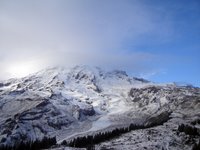
I snapped this image late today before the clouds returned. That is the Nisqually Glacier on Mt Rainier, the trails of the Paradise area in the foreground. The glacier ice looked really blue after the intense rain, and the mountain looked awesome.
For 24 hours, this was a place that people simply left. Today, the NPS resummed its plan to restore facilities and order to the park after 18 inches of rain fell at Paradise in 36 hours. The level of the primary rivers and tributaries remains high and it's very easy to note the newly scoured banks and freshly deposited log jams along the river corridors.


There was a noticeable change to the silence as the restoration effort moved forward. Electricians, water treatment specialists, and heavy equipment operators returned to Longmire and other parts of the park to assess the damage and begin the repairs. Highway 410 will open soon (probably Thursday) but the Carbon River road, Highway 123 and the Nisqually to Paradise road will remain closed (probably for a few weeks).

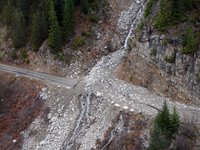
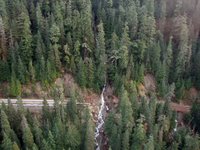
We surveyed the storm damage from the air this afternoon. The main hits were taken at Sunshine Point, Stevens Canyon (in somewhat predictable locations, see photo above-left) and on Highway 123 (left) where the road washed out entirely. The damage to Highway 123 looked severe given the time of year; I wonder if it won't be fully sorted out until 2007. At the Sunshine Point washout, I saw earth movers in the remains of the campground (now river bed). They were trying to make things happen for the road to Longmire, but the job seemed large because the road was entirely gone.

The sound of silence approaches, as soon the generators will be turned off for the evening.

Thursday, June 14, 2012

Hot, Hot, Hot

The temps are soaring in Washington, and gaining altitude on Mt Rainier is one way to avoid the heat. The last two weeks of July and the first two weeks of August historically mark the highest success rates and most reliable weather for the peak. If you're climbing, leave early, as the freezing level is hovering around 15,000 feet.

Recent mountain achievements include Jason Edwards personal climbing benchmark. Jason successfully made his 300th summit climb of Mt. Rainier on July 12th. Jason joins an elit clan of guides (there are only 6) who have more than 300 summits. The current summit record is held by George Dunn, who has over 480 successful ascents.

In other news, we've updated the route condition reports for the Kautz, DC, and K Spire to name a few. Please keep the updates coming.

Tuesday, June 12, 2012

The Feel of a Smaller Wheel

Sogreni Young Shatterhand, Fork


This spring I've been test riding a 26" wheel Sogreni city bike, and some readers have asked what I think of the 26" wheels - specifically, do I find the handling sluggish and do I think the frame could fit a 700C wheelset. The answer is that I do not find it sluggish at all, and believe that the 26" wheels were a good choice for this frame - allowing for aggressive front end geometry with no toe overlap. The bike is pretty fast and maneuverable, and I do not notice the wheel size at all.


Back when I was riding a Pashley Princess and describing the handling as slower than several similar bikes I'd tried, many expressed the opinion that this was due to differences in wheel size. The Princess is fitted with 26" wheels, whereas the other bikes I compared it to were fitted with 28" wheels. Despite a few contradicting voices (most notably that of Jan Heine), it is commonly believed that larger wheels are faster, and that it is always better to use 28" or 700C rather than 26" or 650B, unless the builder/manufacturer is trying to achieve something specific with sizing or clearances.


While I cannot contribute scientific evidence to the wheel size debate, personally I am comparatively indifferent at this stage. I've ridden fast bikes with 28" wheels, 700C wheels, 650B wheels, 26" wheels. I've ridden slow bikes with 28" wheels, 700C wheels, 650B wheels, 26" wheels. Recently I tried a very cool 26" wheel roadbike, made by Richard Sachs for a local cyclist. I would need to put it through a real road test to really comment about it, but around the neighborhood I could not discern any difference in handling, any hesitation in accelerating, compared to a 700C roadbike. And the proportions work so nicely for a cyclist of shorter stature, maybe even for someone my height. I am surprised that shorter women getting custom frames don't go for 26" more often.


Brompton P6L-X, Fenders

Folding bikes and mini-bikes suffer even more from the small wheel bias. Just the other night a friend was telling me that he finds the idea of a folding bike convenient, but cannot imagine the small wheels being adequate. Having ridden Bromptons on a number of occasions now, I disagree as does the Co-Habitant. While I am sure that some folding bikes are slow, it probably has more to do with how the bike itself is designed than with the small wheel size. To me, the 16" wheels on a Brompton feel no slower than full size wheels. I have also spoken to cyclists who ride Moultons and Bike Fridays with dropbars as their main roadbikes, finding them more than adequate for club rides and pacelines.


I am not saying there are no discernible differences between wheel sizes, all else remaining equal. But in the scheme of things, there are so many other factors affecting speed and handling, that I feel the importance of wheel size is disproportionally stressed. It seems to me that getting the tubing, geometry and positioning just right for a cyclist of a given size should be the primary goal, and the wheel size should be a function of that - not the other way around. I am open-minded about smaller wheels and would like to try more bikes with them.

Sunday, June 10, 2012

Orange Tip of the day


Orange Tip battling against the breeze


The Seasons are changing, and so are the routes...

This past week has brought intense thunderstorms, new snowfall, and crisp fall air to Mt. Rainier. With these changes in the weather, we are also seeing changes on some of the routes. See the Disappointment Cleaver page for information on the latest developements there. The upcoming week looks like it holds beautiful weather, so come on up to Mount Rainier National Park and enjoy the stunning scenery, the wildflowers, and the melted out hiking trails before fall truly takes hold!


Friday, June 8, 2012

One Question Answered

After one day at the Family History Library in Salt Lake City, I've already found the answer to one question "left over" from my Switzer research!


As noted in the post Not One, Not Two, Not Three, but Four of Them! (about half way through the post) there was a question regarding which Jacob Switzer was the owner of 80 acres in the W ½ of the SW ¼ of R2 T12 S16 in Fairfield Township, Columbiana County, Ohio.


The answer came in a deed record (volume 64 page 397 of FHL film 926962) in which Isaac Switzer and Christiana his wife, Benjamin Switzer and Lidia Ann his wife, Levi Switzer and Hannah his wife, Peter Keck and Delia Ann his wife, James Crooks and Eliza his wife, Anna Switzer and Sophia Switzer of the county of Columbiana sold the parcel “containing 72 acres of land owned and lately occupied by Jacob Switzer deceased” to Christian Kiser for $3420 on April 6, 1860.


So now we know that this land belonged to Switzer Family Number 4 :: Jacob G. and Catharina and not to “my” Jacob. In addition, it confirms the names of his heirs and provides the names of the spouses of the married children, which would be nice for anyone researching this particular family!