Sunday, June 2, 2013

Chipmunk


Look hard and you can see the tiny chipmunk on the left side of the tree stump. We saw him last time we went to the mountains.

Thursday, May 30, 2013

Summit Trips and Road Access

Winter-like snowfall continues on Mt. Rainier, but you can feel the presence of spring and the coming summer in the air. Many climbers are planning summer trips; reservations are in full swing, and the guide services are working again on the mountain.

The best Mt. Rainier climbing news, of late, is the recent summit by two independent climbers. Tim Ryan (photo credit) and his partner (Erik) hiked in from the Nisqually Entrance (i.e. park boundary) up the Tahoma Creek drainage and to the summit via the Tahoma Glacier. Their trip report is here (almost verbatim).

Of interest to many is the updated list of road openings; there are no major surprises. Along those lines, the Nisqually to Paradise road is nearing completion. Park crews have reconstructed the embankments at Milespost's #5 and #9. In the next few weeks, the road crew hopes to complete the installation of two massive 12-foot culverts at Kautz Creek. They're still calling for a May 1 opening (barring unanticipated delays) and plan a "media day" once the major repairs are completed (just in case there wasn't enough press already).

A quick word on campgrounds... Cougar Rock Campground will be open May 18th, one week earlier, to help offset the loss of Sunshine Point. Otherwise, it's business as usual at the other locations (except for Ipsut Creek).

Monday, May 27, 2013

Cycling without Fear

Aqua Velo

I talk to a lot of beginner cyclists who are afraid to ride on the road. Some try to conquer their fears by riding anyway, only to find that they end up being more afraid, not less. The proximity of the passing cars frightens them so much, that their bike handling suffers. This in turn makes them more likely to experience close calls and drivers honking at them, terrifying them even more. It becomes a vicious cycle.


Fear is a nasty, crippling emotion. I don't mean the philosophical kind, where you are thinking "Gee I don't think I can handle this." What I mean is the visceral kind: that sinking feeling in the pit of your stomach, adrenaline, heart racing,trembling, weak at the knees. It is debilitating and difficult to control. But it can be avoided.


If an aspect of cycling scares you at a strong visceral level, my suggestion would be to take it down a notch - to a point where you do not experience the fear - and work from there. If cycling on busy roads gives you panic attacks, try riding on quiet side streets exclusively, until that feels so comfortable that you are ready for the next step. If even that is too much, stick to bike paths, parks and empty lots until you are ready for side streets. If your neighbourhood has none of these things, try riding in the middle of the night or very early morning (with good lights of course). Even in a busy city, the roads will be nearly empty. Whatever it takes, find a way to ride so that you are relaxed and not in panic mode. I would apply this to every aspect of cycling - from riding for transportation, to learning new skills, to trying drop bars, clipless pedals, and riding off road.


It's also important to understand that when we ride with friends and spouses, their level of comfort may be very different from ours. Without meaning any harm, they might coax or pressure us to do things we cannot handle. When we are ready for it, being encouraged to push ourselves can be a good thing. I've certainly received more than a couple of nudges that were helpful. But overcoming nervousness or timidity is one thing. Intense, limbs-atremble fear is not good and can affect our behaviour in unpredictable ways. It is our responsibility to know the difference.


Conquering one's fears is a worthwhile endeavor. But it takes time and there is more than one way to approach it. In my experience, those who find cycling more frightening than enjoyable, stop cycling. Therefore, I suggest sticking to riding in a way that feels fun and avoiding riding in a way that feels terrifying. Cycling should be a positive experience.

Sunday, May 26, 2013

The Deer's View


Later, after the deer had gone - where ever they go - I wondered up to where they had been and took a photo of their view. You can see it was a long way from the house which is alm ost hid behind trees and a grape view. To the right is an old barn that has been converted to a garage, and to the left is Jim's workshop.

Friday, May 24, 2013

Monday Mailbox: Treating Saddle Sores

Treating Saddle Sores

Monday Mailbox is a series of posts dedicated to questions received over email. Here is one that pops up now and again:

This is embarrassing, but lately I've been getting what I think are saddle sores after long rides. How can I tell that is what they are? And do you have any advice for treating them?


Saddle sores are one of those common, yet mysterious problems that cyclists love to discuss endlessly. I am just one voice among many and by no means an expert. Happily, I was spared the affliction of saddle sores for my first three and a half years on the bike. It is only recently, when I started covering longer distances, that I began to get them occasionally.


What exactly is a saddle sore? Part of the reason there is so much mystique and different advice out there, is that there is no single medical definition. But at least everyone agrees about their location. Saddle sores appear on the crotch, where it comes in contact with the saddle. Popular spots include the uppermost inner thighs, the "taint," and that transitional ridge where leg becomes butt.


One opinion is that saddle sores are boils caused by abrasions. Another is that they are some special, horrible type of cyst that forms as a result of fluid buildup. But probably the most popular opinion is that they are infected hair follicles. It is very possible that in fact they can be any or all of these things, depending on the rider and cause - which also means that treatment and prevention methods might differ depending on what type it is. Based on my own observations, the infected follicle theory makes the most sense, so that is what I am going with. And as it happens, I've discovered a fairly quick and simple way to get rid of them. Who knows, it might work for you. So here is what I do:


After a ride, shower as soon as possible using non-perfumed soap. Once the area is clean, you will need two ingredients: tea tree oil and vaseline. It's important that the tea tree oil is just that, and not, say, a moisturiser containing it as an ingredient. Plain tea tree oil is now available in many mainstream pharmacies, so sourcing it should not be a problem.


Using a cotton swab, apply tea tree oil to the affected areas - but be careful not to get it onto any mucus membranes, as that could hurt. Once it dries, follow up with vaseline. Repeat every few hours, washing the area before each re-application.


While the sores heal, either stay off the bike, or ride a bike where the way your crotch contacts the saddle is sufficiently different. Wear breathable underwear made of natural fibers.


Using this method, any saddle sores I get go away within 2-3 days. For anything more serious I have no advice, as I've never experienced it myself. Needless to say, if your sores are not going away, consider seeing a doctor.


As far as prevention, there is of course the common sense advice: Find a saddle and shorts that work for you. Increase distances gradually.Use chamois cream to reduce friction. Be sure to shower before and after every ride. And always, always wear clean shorts. However, this is not always sufficient. Even the cleanest, most hygienic pair of shorts will turn into a bacterial cesspool after 10+ hours of riding. Even the most comfortable saddle can start to chafe eventually. And even if you start a ride squeaky clean, you will soon get filthy. That is to say, I don't think there is a sure prevention method once you start doing long distances. Some riders are more prone to saddle sores than others and some situations (such as hot weather) are more likely to cause them. You just have to deal with it when you get them. Hopefully for most of you saddle sores are just an occasional nuisance and not a serious problem.

Finally some real ice in South western Pennsylvania


The south western Pennsylvania woods are finally looking like winter


Laura and I decided to take our chances and head into Sunday School Crag to try and climb one of the new lines I found last week. It was a warmish 29° when we left the house and made our way up to the parking area. Upon arrival it was 23° which made me feel more optimistic that the line would have held over the warmer days this past week.


Parking area for Sunday School Crag
During our hike in to the climbs we were breaking through the crust that the recent ice storm left in its wake. I knew this recent ice crusting might be of some concern on the lines we were going to try and attempt. Sunday School Crag is the most alpine like crags of south western PA.


Coming out of the woods and into the crag
The temps are always colder, the wind is always howling and is usually downright uncomfortable. The ice lines are a lot more committing than most other local crags, with traditional gear being involved in most ascents. Most lines I've climbed here commonly involve some sort of barely held together limestone choss with varying thicknesses of verglas beteween sections of ice pillars and runnels. In other words some seriously fun climbing that might make you stain your drawers and then smile about it after its done.

On the way in we scoped out some of the lines. Here's a couple we want to try in the near future.


Laura below one of several unclimbed lines we eyed


One of the top options for the day!


Not sure if I should be excited or terrified for this one.

Either way its an incredible looking mixed climb that I want to try.


After checking all the other options, we headed to the long alpine looking corner route I found last week. I was really hoping it was in. I had thought about it all week and couldn't wait to get on it. We rounded the corner and it came into view and was looking at least as good as it did last week. I was afraid that the water might have started to wash it out from behind. The temperatures must have been quite a bit colder here that at our house. The climb had very little water running off of it and looked as if it were good to go. The climbs to the right were running hard with water and were dropping some rather large chunks of ice.


Standing near the bottom of our chosen climb


The climbs to right on this wall were running hard and dropping ice


We didn't waste much time. I've never been on this line and had seen it for the first time last week. I looked it over and scoped out a potential line and racked up accordingly. Going ground up is always a little more exciting and I find over-racking is better than under. The line looked a little boney so it was mostly 13cm screws. I also racked some quick draws, a few runners, screamers, a half rack of nuts, and 3 cams. Plus belay coat and gloves, belay device, thread tool, cordage, spare biners, a 22cm screw for a thread if necessary/possible. I recently received a set of the new Petzl dry T rated picks (which is a whole other post in itself). I'd been anxiously waiting to try them on an "ice" route. I resisted the temptation to take them dry tooling and dull the hell out of them over the past couple of weeks. Also new was a shiny pair of Grivel G4 crampons, complements of Rob "Griz" Ginieczki for helping with the second revision of Ice Climbing Pennsylvania (available for purchase soon). All this new gear to try and on a new line, How cool! I'd used the previous versions of the Rambo's over the years and always liked their rigid frame for pure ice. My last pair were hijacked by Laura (who likes them a lot as well) and I just hadn't replaced them when Griz surprised me with these. Thanks again Griz.


Racked and excited to get on some real ice!
The climb was well... Awesome! What a great first ice route of the season. It went well. The ice was mostly very thin. There were plenty "eyelids" on the bulges from the ice storm as expected. Lots of new ice and snow to be cleared as I ascended the runnels that flowed down the 200' cliff. Even with a "soft" swing attitude today I still managed to put falcons beaks on both of my new picks. They performed well and I can say that the new picks perform better on ice than the old Astro picks that I loved so much. Now that I've used them on an ice route I can go out and trash them at will. I have a few more sets coming my way. I'm definately NOT a fan of the new washer design that has now made changing picks in the field a big pain in the ass. Right up there with Grivel's three bolt system. The crampons were sweet as expected! Grivel has the rigid design and point configuration nailed. The extra weight seems to help drive them into the ice with much more authority than the Petzl Darts I've become used to.

We named the line Late Bloomer. We thought it a fitting name for our current season being the worst ice season in area history. Climbing this line today almost made me forget how unproductive local ice has been this season. I'm a little hesitant to grade the line. I'm sure it'll be much easier during a normal season of cold, producing plentiful ice. Today it felt like a commiting WI4+ in lean condition. Protection was a little sparse and I would not recommend this climb for the budding WI4 leader. What it lacked in vertical sections it made up for in sparse protection and lack of ice. Here's the photos of us on the climb.


Starting up the line it got thin early on


Short thin pillars with a few mixed moves, very alpine feeling


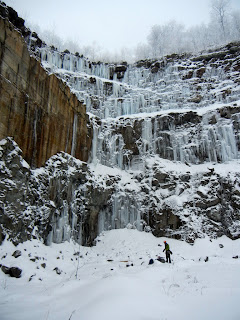
I'm in the middle of the photo, Giving scale to the climb


Just another day in the Pennsylvania alpine


Laura moving over a lower angle snow/ice slab


Even enough ice for a V thread rap!


Laura is all smiles on this one!

Late Bloomer WI4+

South Western Pennsylvania


Is there more? There's always more here in SWPA


The End!
So south western Pennsylvania ice season has officially begun for us. Who knows if February will contain colder temps and provide us with more lines to try this year. Hopefully it does. Keep checking back for all our PA climbing nonsense. With some luck we'll be able to send a few more of the new lines at this crag. I hope everyone got as lucky as we did this weekend! What a blast... cant wait to get back for more!

Thursday, May 23, 2013

Velo Vision

Focus
About a year ago, I started to notice that I couldn't see things in the distance as well as I used to. I could read and see up close just the same as before, but things far away were losing their clarity. I noticed this most of all while cycling.The landscape was not as sharp as it once was, far-away roadsigns were more difficult to read, faces of people riding toward me were harder to recognise. As someone who's always had perfect eyesight, I had no prior experience with vision loss and it took me a while to acknowledge what was happening. But finally I went to have an eye exam and the loss of "perfect" status in the eyesight department was confirmed. I was given a prescription for glasses that the doctor said I would need mostly "for driving."


Glasses

I expected shopping for glasses to be a nightmare, for the same reason finding a decent pair of cycling sunglasses had been a nightmare. But I underestimated modern technology and our neightbourhood's offering of optical shops.Picking up friends' glasses in the past, I remember them being heavy. But apparently eyeglasses today can be made extremely lightweight - with high-tech plastic and titanium frames. There is also enormous variety in shapes and sizes. I had no problem finding some that fit my face and weighed next to nothing.


Glasses

With cycling in mind, I got a pair with plastic frames and photochromic lenses. They cover a good part of my face, and the lenses turn dark in the sun, but clear at night. I have already worn them on a couple of rides and the fit is very comfortable.But wearing corrective lenses will take some getting used to!Everything in the distance now looks unnaturally sharp, or hyper-3-D. My feel for how close or far away objects are is a little disturbed by this, but I am assuming my brain will adjust eventually.


Focus

Another thing that's happening, is that whilethe glasses correct my far-away vision, they do so at the expense of making things blurry up close. On the bike, this means that I can't really see anything that's directly in front of me or at handlebar level (i.e. the cycling computer on my roadbike) unless I take them off or look underneath the lenses. I am still working out how to adapt to this. Meanwhile, it's a relief to see clearly at a distance again.